30 knots, 30 degrees, 30 topics. At least.
26 October 2026
The second Session on the Sea had a crew of two, the day Linda — aka Phoenix — dared to set foot on Aurora, on a (too) warm spring afternoon of flat water and strong gusts. Linda Baird, CEO of a eucalypt-conservation trust by day and our Sea Scouts group leader for years, opened the session a day early, by text: “I’m trying to pick a topic that has some optimism but I’m struggling!! It won’t be much fun.” So we started with: Fun: a reef in the main, the jib rolled away entirely, and a personal speed record of eight knots in a gust.
The only boat out, and a quick one: Port Melbourne to St Kilda, across to Williamstown and back, two channel crossings, all before the sun came anywhere near the horizon.
If you have sailed a strong northerly in Melbourne you will know the pattern; for everyone else: the northerly brings the heat, it runs strong to very strong, and even when the wind graph reads a civilised eighteen knots it is the gust that wants watching — thirty-five, nearly seventy kilometres an hour, arriving in the same breath. The gusts come short and hard and shifty as anything, bent and deflected and blocked by the city towers standing between the bay and the north. Short, strong, wildly varied — which, it turned out, was also how our topics came: broken up by quick kicks of adrenaline, both of us out on the rail, sail eased, the odd “I think we are about to get wet” that reset the conversation each time. Of course we started with Scouts, and, as ever, ended up at education — Linda, as it happens, shares my view of it; it is a large part of why she took on the “little side project” of reviving 1st Victorian Sea Scouts a few years ago, from nearly forgotten to a bustling hub of adventure again. A natural enough drift, until a gust kicked us off it and I remembered to ask: “hang on — why did you say you could only think of grim topics?” Which took us straight to politics, international down to national, the real worry being the extreme polarisation of a country, and the hope that we might steer clear of the trajectory other nations are on. Thirty degrees, a twenty-five-knot gust, the boat heeling hard. Pause. “Few people really doubt climate change is real by now…” “…but not a great deal is actually happening?” That led us not into climate change itself but into conservation — caring for the land, and for its people. You know how the Indigenous people here were treated…? (something I am aware of, and no expert in). A gust cut my answer short: “I think I would call it genocide.” This is where the session turned, for me, because I have not spent much time thinking about that history in Australia before — despite it being, this year especially, a subject of education in our own family (that is for another time). I grew up with the German experience of reckoning openly with a national history: its importance, and also its shortcomings and its pitfalls. Setting that beside other reckonings, the ones tied more to colonisation, something struck me for the first time. Australia’s may be an unusually hard case, because its history of reckoning is so recent — and, more surprising to me, so recent in becoming something the country openly learns about and discusses in public. What I, as a fairly recent arrival, had filed under “ancient history” — not quite understanding why it was still live — is not a matter of “still a topic” at all. It is much more a matter of “only just became one.” Children were still being taken from their mothers, for their “education”, within Linda’s lifetime. I knew that when I moved here. What I had not grasped is that a great deal of the country was only learning it at much the same time I was. A longer run of hard wind left each of us alone with our thoughts for a while, and once the boat was level again we left that one where it sat: wondering aloud whether any comparable country has worked through all of this well enough to offer the rest a bit of a map.
Crossing the channel a second time, we agreed it was a good moment to find something lighter — and arrived, instead, at the question that turns out to unite us both: how to spend one’s time making or doing something that matters. Before I could get out my answer — “I suspect you already do more than you realise” — the bow touched the beach and we were home in Port Melbourne. Our “summer cruise” went from “nothing fun to talk about” — truly — to the two of us, one running a trust to conserve a national icon and one trying to build something that might matter in twenty-five years, still wondering whether there is more we could be doing.
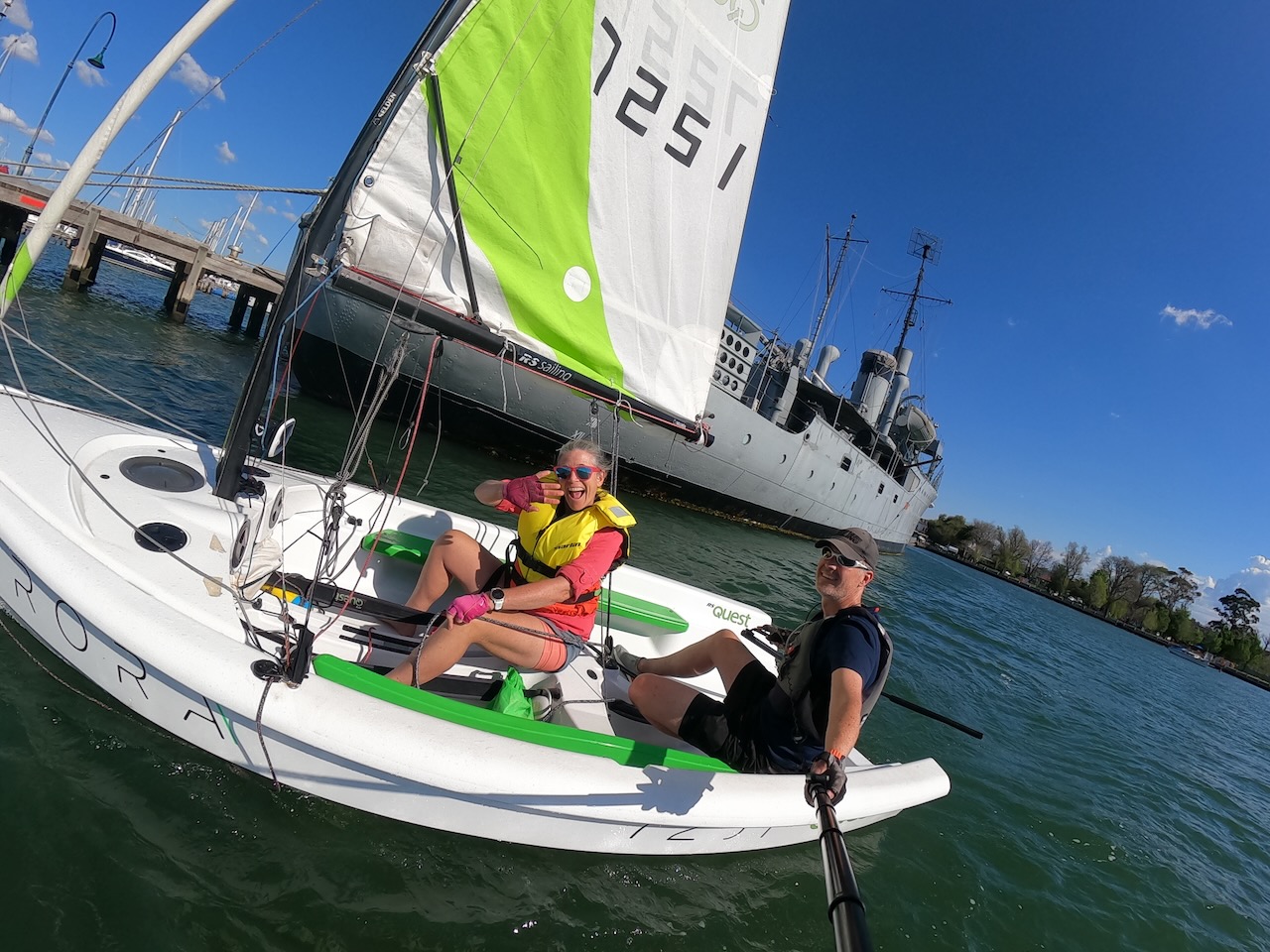
Only three improvements could have made this session any better:
- We both agreed, a third person on the crew, with a third point of view would have really enriched the conversation.
- Linda on the tiller, because, frankly, there was no reason not to, and —
- on a day that warm — a swim, by which I mean a capsize. Both would have been refreshing, in every sense. I give some of the younger sailors this guidance: if you never capsize, you are not pushing hard enough. By that measure we sailed a little too sensibly. Next time, more tiller for the crew, and perhaps a degree more edge.
Aurora is out again on Friday. Reef, hopefully, optional (it was not this time).
Session On the Sea runs Fridays from Port Melbourne Yacht Club through to mid-December.
How it started: Your last meeting of the week.