Ten years early to the longevity party
09 November 2026
Future Assembly, Melbourne, December 2016 · Ageing Well Australia, Sydney, February 2027
A complimentary invitation arrived today: “Australia has hacked lifespan. Now for the hard part.” It is for Ageing Well Australia, Economist Impact’s first conference on what it calls the country’s longevity transition. Five hundred people, the Fullerton Hotel in Sydney, 25 February 2027.[1] The pitch is that our health, finance and housing systems were built for shorter lives, and that the extra years now have to be healthy, productive and paid for. One session is called “Financing longevity: who pays?”
In my 2016 words: “let’s also strap in for higher taxes, higher Medicare levy.” In December 2016, at the Future Assembly in Melbourne, I gave a talk on ageing. “I am German – I have to start with Goethe.” Of course. “Blut ist ein ganz besonderer Saft.” Blood is a very special kind of juice. Mephistopheles, in Faust, 1808.
“Humankind has always been striving for a longer life.” Medea drained the blood of old Aeson and refilled his veins with the juices of plants (I think the idea lived on into the 2020s in the form of curcumin injections…). Sherlock Holmes, in 1923, followed a professor who climbed walls at night, after injecting himself with a serum made from langur monkeys: made up, yes, but “inspired by real events”. The real man behind that story was Serge Voronoff, a French surgeon who grafted monkey testicle tissue onto more than 500 men in France, until the idea was disproved.
Epidemiological numbers are generally less entertaining, but more scientific. In the United States, infections caused close to half of all deaths around 1910, and a few per cent a century later (that is, before COVID came). Heart disease and cancer, the diseases of ageing, went the other way: from about one death in eight to nearly half. In Germany in 2014, the largest age group was the 45-to-55-year-olds, ten to twenty years from retirement, in a pension system where the young pay for the old: a system everyone has known for decades will collapse, yet no one has really done much about laws designed at a time when we had a demographic pyramid. Australia was younger (still is), but on the same road. And in old age, it costs more to keep well: in one American model on my slides, a year of healthcare at 85 cost about twelve times as much as at 20.[2] My notes for this section: “I am not a policy maker, and not even a health economics expert, but somehow, this does not look very sustainable..”
Ageing, I said, was going to be disruptive. There would be change, and there would be opportunity, “for example in regenerative medicine”. A medicine takes about fifteen years from lab to patient, so 2016 was the time to start.
The last part of my talk went back to the blood. In 2005, a team at Stanford joined the circulation of old mice to young ones. The old animals’ muscle and liver cells regenerated as if they were young again.[3] Tony Wyss-Coray, also at Stanford, went on to show that the plasma alone could do part of it. “There’s a startup for this.” Two, in fact. One was Ambrosia, which infused people with plasma from young donors. The other was Alkahest, searching young plasma for the factors responsible.
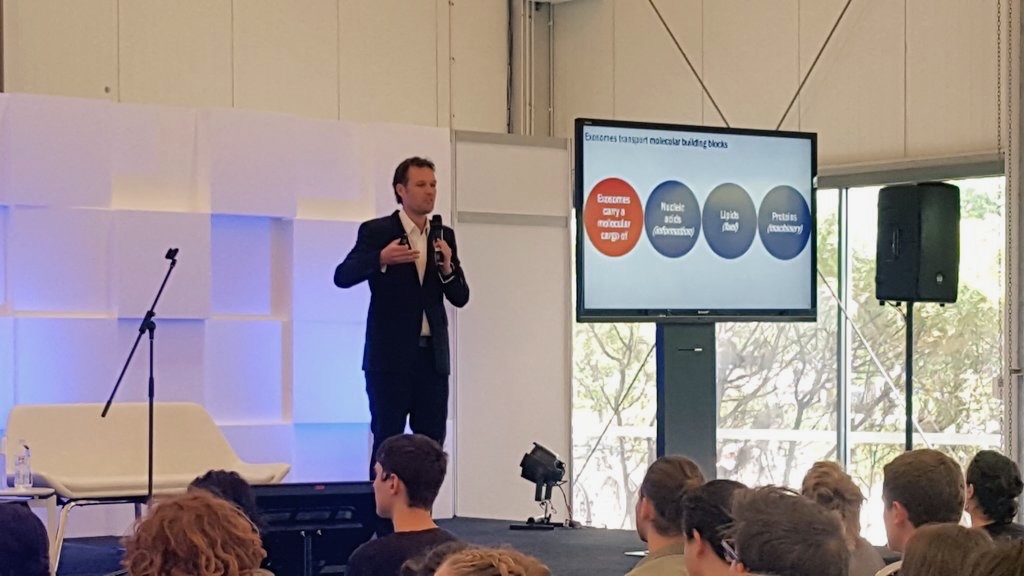
“One more thing…” Blood also carries exosomes: tiny vesicles that cells release to send each other molecular cargo. That is the slide behind me in the photo. Exosome science papers were heading for about 800 that year. I set them against monoclonal antibodies, which passed 500 papers in 1980. The first antibody drug followed six years later; by 2013, antibodies were selling 75 billion US dollars a year. The slide’s title: “Exosomes – you are going to hear about them.”
PubMed now counts 673 papers with “exosome” in the title for 2016, and 2,860 for 2025. Count the field’s newer name too, “extracellular vesicles”, and the decade from 2016 to 2025 produced more than 57,000 papers, including nine of our own, from Exopharm, the company I co-founded.[4] Two have my name on them, among them the first trial in people of extracellular vesicles made from donated platelets (yes, blood platelets), for wounds that were slow to heal.[5] In June, the World Economic Forum put exosome drug delivery sixth on its list of the top ten emerging technologies of 2026, and called exosomes “the body’s own molecular couriers”.[6] Someone must have finally read our 2022 investor presentations.
Not all of it aged as well. In May 2017, HBO’s Silicon Valley gave its tech billionaire a “blood boy”, a young man on call to top him up.[7] On 19 February 2019, the US Food and Drug Administration warned that plasma from young donors had no proven clinical benefit. Within hours, Ambrosia announced that it had ceased patient treatments. It had been charging 8,000 US dollars for a litre, or 12,000 for two.[8] And no exosome medicine has yet been approved for use inside the body.[9] The first US decision on an exosome-related therapy is due on 22 November: Capricor’s deramiocel, for Duchenne muscular dystrophy. Technically, it is a cell-based therapeutic, which attributes its effect to the exosomes and other extracellular vesicles its cells release. The Sydney agenda has sessions on healthspan, on the economics of ageing, on 100-year lives, and on who pays. No Goethe, though, I assume.
For us, the conference comes about seven years too late.
Being early feels a lot like being wrong. Ten years later, it feels better, in a way. But feeling better doesn’t change the outcome.
I am marvelling at my slides from 2016, and at the roughly $99 that my holdings from those years are worth in 2026.
But, the experience: priceless.
Sources
- Economist Impact, Ageing Well Australia, 1st edition, 25 February 2027, The Fullerton Hotel Sydney. Complimentary invitation email, “Australia has hacked lifespan. Now for the hard part.”, 8 November 2026; event page and agenda topics, checked 9 November 2026. events.economistenterprise.com
- Alemayehu, B., Warner, K. E. (2004), The lifetime distribution of health care costs. Health Services Research 39(3): 627–642. Modelled annual spending of US$1,448 at age 20 and US$17,071 at 85, as shown in the 2016 talk. doi.org
- Conboy, I. M., Conboy, M. J., Wagers, A. J., Girma, E. R., Weissman, I. L., Rando, T. A. (2005), Rejuvenation of aged progenitor cells by exposure to a young systemic environment. Nature 433: 760–764. doi.org
- PubMed (National Library of Medicine), counted 9 November 2026: papers per publication year with “exosome” or “exosomes” in the title (2016: 673; 2025: 2,860); papers from 2016 to 2025 with “exosome(s)” or “extracellular vesicle(s)” in the title or abstract (57,508), of which nine carry an Exopharm affiliation. pubmed.ncbi.nlm.nih.gov
- Johnson, J. et al. (2023), First-in-human clinical trial of allogeneic, platelet-derived extracellular vesicles as a potential therapeutic for delayed wound healing. Journal of Extracellular Vesicles. pubmed.ncbi.nlm.nih.gov
- World Economic Forum and Frontiers (2026), Top 10 Emerging Technologies of 2026, published 23 June 2026. weforum.org
- HBO (2017), Silicon Valley, season 4, episode 5, “The Blood Boy”, first aired 21 May 2017.
- CBS News (2019), Startup halts treatments using young people’s blood after FDA warning, 19 February 2019. cbsnews.com
- Meticulous Research (2026), Exosome drug delivery and the future of targeted therapeutics, October 2026: no exosome product yet approved for injection or systemic use in humans; the US decision on deramiocel due 22 November 2026. meticulousresearch.com