The day the SHRMP students went fully AquaCore
13 August 2026
For some university projects, the students never have to leave the room. Or look up from their computer. Especially if it’s pure “knowledge work”. They get an assignment, they may meet on campus, they may present to the person who gave them the assignment, and get a mark. A SHRMP.bio project is not that. And our students went for a deep dive today.
The Australian Regenerative Medicine Institute at Monash has a secret in the basement that is worth a visit. In its basement is the AquaCore facility housing zebrafish, medaka, killifish, axolotl and sharks (as model organisms for biomedical research)… and it is also housing a group of scientists and professionals who keep aquatic animals alive for a living. Today, my Master of Biotechnology students went to visit and to discuss their work. They explained what they’d been working on over the past months — for the first time, to people who know aquaculture inside out.
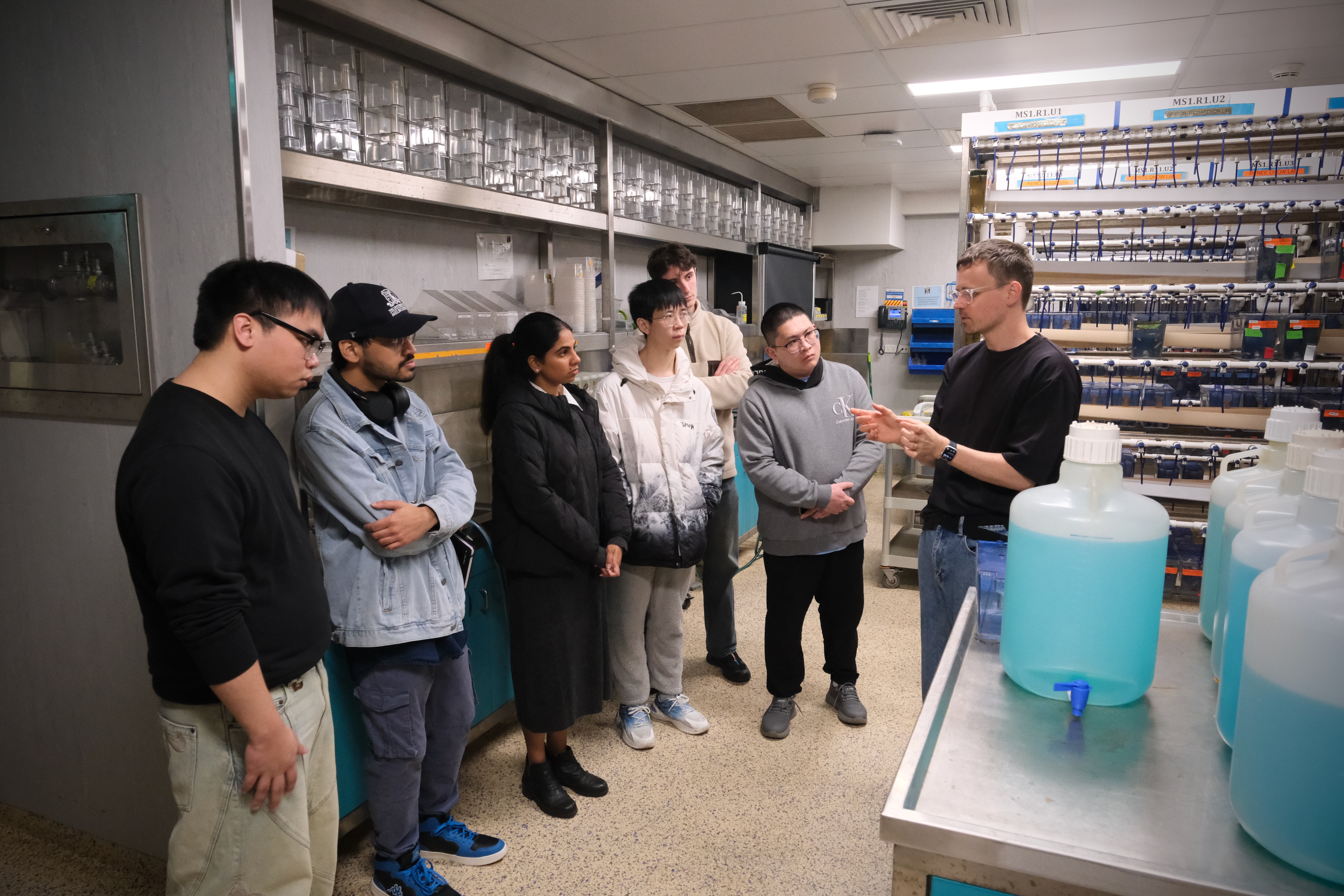
Why a regenerative-medicine institute, of all places
A visit to ARMI is in fact closing a loop for SHRMP.bio. Very broadly, the idea behind SHRMP grew out of a regenrative medicine application see SHR!MP S01E01, so technically, as far fetched as it may sound, SHRMP is coming home. But ARMI was also the perfect fit for the students. The obvious audience for a prawn-farming project is an aquaculture group — but that can be an intimidating audience, and we weren’t looking for an academic challenge - yet. What the AquaCore offered was an expert audience, adjacent enough to share real knowledge without assessing a hypothetical grant application. Also, ARMI keeps and studies aquatic animals at a level of biological control most aquaculture operations never touch. For the team working on the far frontier of aquaculture, there is no better-matched audience in the city. Aside from that, the next prawn farm is about 3000km North of us.
What the SHRMP.bio team is doing
Two teams, two horizons.
Team A is asking whether SHRMP.bio should build a pilot facility — a shipping-container-scale prawn farm — and whether the numbers hold up. Ashit Sreekumar owns the market: whether there’s a commercial reason to build any of this at all. Catherine George owns the intellectual property: which parts of the system somebody already owns, and which parts are ours. Ed Burns owns the technology: what we’d have to build, and what we could buy off the shelf.
Team B is asking the longer question — not the farm, but the research frontier fifteen years out. Noah Kalesaran works on feed: how you move a farmed animal off wild-caught fishmeal and onto something fully designed. Ziqi Wang works on breeding, and on the parts of it that don’t exist yet — lab-grown approaches, cell lines, the biology that isn’t in the textbook because nobody has done it yet. Jeffery Wang works on water and automation: whether you can trust what the sensors tell you, and whether the system could eventually run itself.
What the sprint is for
In Semester 2, we changed things up - from a typical academic assignment to a real-world project. Really in the real world (see above). With real outcomes (see below). The last four weeks were not for producing a polished paper. They were for finding and answering the questions that could stop the show.
Where SHRMP is going
SHRMP.bio has said publicly what most startups never say: that it has no viable future as a startup in its current form, and that its future is research — finding an institution to take the work on and make it real. That’s not a failure. It’s a finding. The asset is the accumulated work and the ideas, and the job now is to find them a home.
Which is why the students went to a research institute rather than a boardroom. The trajectory of what they’re doing points at a lab. Standing in one, being asked real questions by people who run one, wasn’t a field trip bolted onto the project. It is the project in its natural habitat.
Real student outcomes
And the team didn’t even know about the best part. Their sprint contributed to an application to CSIRO’s Innovate to Grow: Aquaculture programme, which we also just submitted this week. They may be officially doing a university project; but SHRMP.bio is building on it and we sent it somewhere real.
With thanks to…
to Greg Kubik & Daniel Czech for enabling another year of SHRMP projects at the University of Melbourne and Rodney Glanvill, Sam Crossman, Jan Kaslin and the whole AquaCore team at Monash for making this day happen.