The giant prawn Australia hasn't farmed (yet)
04 November 2026
Prologue · A history of the giant freshwater prawn
A large male giant freshwater prawn carries two blue claws, each about twice the length of his body.[1] Head to tail, the biggest males reach around 32 centimetres.[2] A shrimp the size of a ruler.
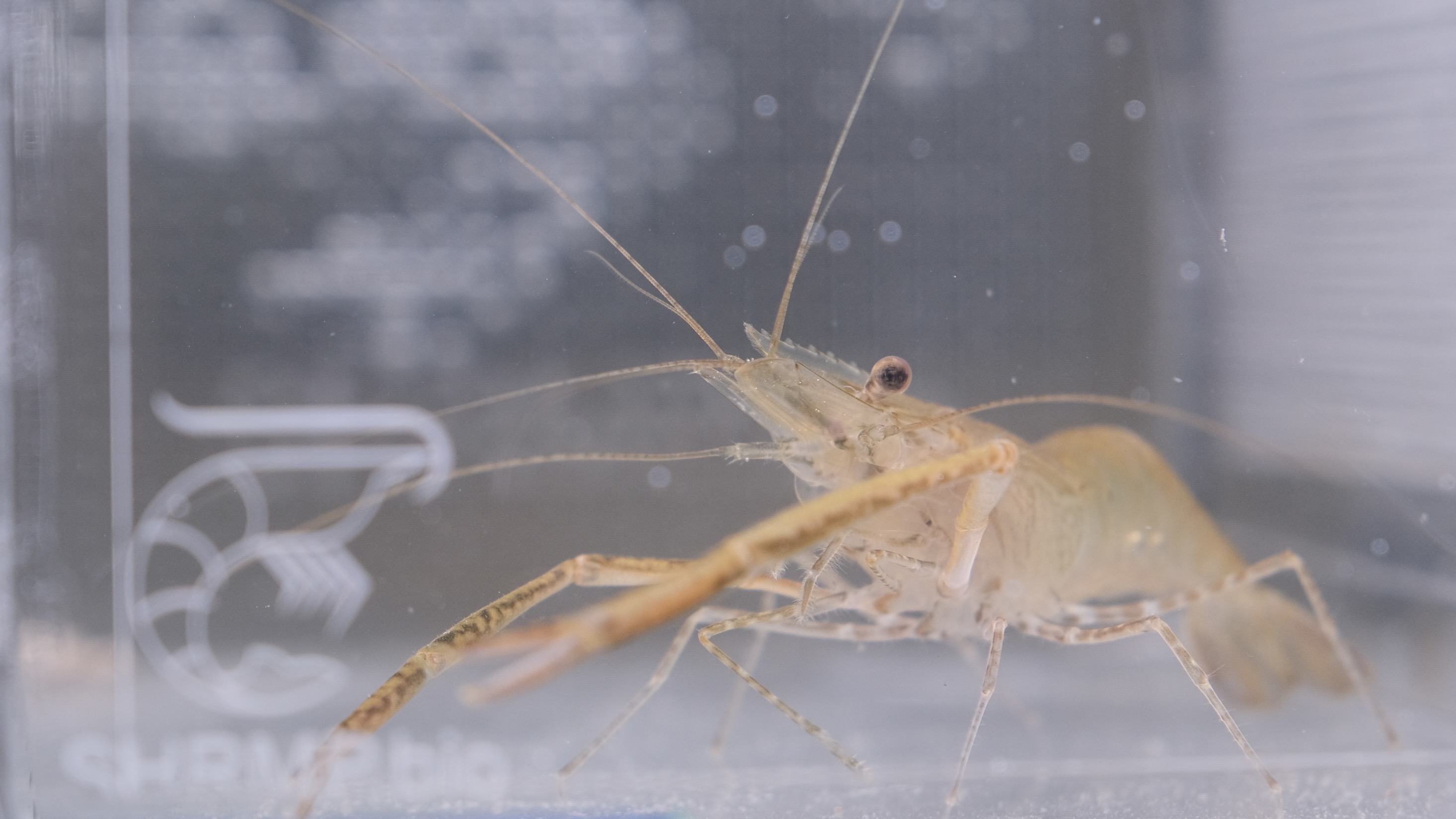
The species lives in the rivers of northern Australia, from the Kimberley to Cape York. Aboriginal people have caught and eaten it for thousands of years, and in the north it goes by local names, cherabin among them.[3] Across Asia, giant freshwater prawns are farmed at about 300,000 tonnes a year, more than half of them in China.[4] In Australia, where the prawn is native, there is no commercial production at all.[5]
I have spent nearly three years with this species. In all that time I have not found its story told anywhere in one piece. But it’s a good story.
Over the past months I wrote a series on why SHRMP.bio is not building a prawn farm, and why it is looking for a research home instead.[6] That was the why and the how. This series is the what: the species itself, seventy years of people trying to farm it, and a question about it that the industry set aside in the 1980s and never finished answering.
It comes now partly because of timing. For once, fortune has been with us: a dedicated aquaculture programme surfaced just when we were looking for one, and with it a group of people who share our enthusiasm and curiosity, and our conviction that this species could be of value to Australia. In September, SHRMP.bio joined CSIRO’s Innovate to Grow: Aquaculture, a free eight-week programme that pairs small companies with researchers to establish what research an idea needs.[7] Our coach is Associate Professor Tomer Ventura of the University of the Sunshine Coast, an expert with deep knowledge of this species, and an exceptionally helpful coach.
It is also more than SHRMP.bio’s story. The people working on this prawn in Australia are few and far apart: researchers in Townsville, Brisbane, Darwin and on the Sunshine Coast; two Aboriginal-led ventures, the Hope Vale Foundation on Cape York and Emama Nguda Aboriginal Corporation in Derby; and the programmes and funders that have backed them. The parts that follow put their work into one story, crediting each in turn.
Seventeen parts follow, most of them short: the hatchery that taught the world to breed the prawn, the farms of Thailand and the fishing ponds of Taiwan, the export rush and its collapse, the question about the water, the prawn’s senses, its Australian story and its change of name, and, at the end, what SHRMP.bio plans to do about it.
It starts with a problem that defeated everyone who tried to breed the prawn until the early 1960s: its young cannot survive in the water their parents live in.
Sources
- Barki A, Karplus I, Goren M (1992), Animal Behaviour — claws of large blue-claw males about 25.7 cm on a 13 cm body. doi.org/10.1016/0003-3472(92)90064-g
- FAO, cultured aquatic species fact sheet, Macrobrachium rosenbergii; Wowor and Ng (2007). The often-quoted maximum (320 mm) was given for the two species together, before they were separated. FAO fact sheet
- Australian Faunal Directory, Macrobrachium spinipes; ORIC (2019), Aquacultural pioneers; Coles Group (17 June 2026). AFD · ORIC
- FAO statistics: about 294,000 t in 2020; estimates for 2021 run from about 300,000 t to 314,000 t, with China just over half. Pillai and Panda (2024). Journal of Aquaculture
- Hope Vale Foundation, reported by Cape York Weekly (2026) and CSIRO (2026). CSIRO case study
- The SHRMP.bio strategy series. shrmp.bio/strategy.html
- CSIRO, Innovate to Grow: Aquaculture. csiro.au/aquaculture
Prologue · A history of the giant freshwater prawn · Next: Part 1, The larvae that needed the sea · SHRMP.bio’s strategy behind it: shrmp.bio/strategy.html