The road to a symposium on Higher Education
02 September 2026
I have one key personal flaw. I cannot see something and do nothing about it — not when I could.
Therefore, I built a one-hour talk for my students that had nothing to do with the project I wanted them to work on, and everything to do with how to think when the ground moves.
In a way, this is also the normal state of working in a startup, so it’s also a fitting part of my contribution as a university (startup) industry partner.
I started writing the talk up as a book, too - but for teenagers - because high school age is when one should learn these skills. I put more effort into Scouts and Youth Sailing, for the same reason - less to provide outdoor fun than an environment to learn resilience. The youth and students taught me a lot. For ten years I have worked with university students as an industry partner, not a lecturer — real projects, real deadlines, and also hiring the ones who were ready. At least nine of them, at Exopharm. You learn a lot about an education system by standing just outside it and catching what it sends you.
What I caught, more recently, I could not fully understand. At first it seemed to be the students - of course. I started to question whether they could still read at all - yes, really. That is a long way from “employability”.
That would have been the easy answer. “Those students nowadays…!” I caught myself saying exactly that. And there seemed to be agreement from whoever I talked to, from academic staff, industry. From other countries as well. Then I caught myself doing the one thing I had told my students to watch for in my “special” intro talk. One slide, near the beginning, is titled:
“The world you’re graduating into is not the world your lecturers trained for.”
I wrote that myself. Such irony. Had I turned into exactly that “lecturer”?
And, realistically, one student not living up to expectations - sure. All of them? It could not be the students, at least not alone. Could it be me? Uncomfortable thought. Moving on. Could it be the design of education around them? What exactly is a university’s role today? Not a question I spent much time thinking about so far, because I am not a lecturer, not a university employee, not an education policy maker. I have no real stake in university education, nor responsibility for student outcomes - but I have responsibility for my industry project outcomes - and whoa, that did not look good around mid-year. And I was debating whether to just walk away from those.
Yet, for this year, I had committed. And I like doing what I said I would do. And I like overcoming challenges. We were at half-time, with 4-5 months still to go. I changed everything I could change on the design of my projects. Whether that made a difference, that experiment is still running.
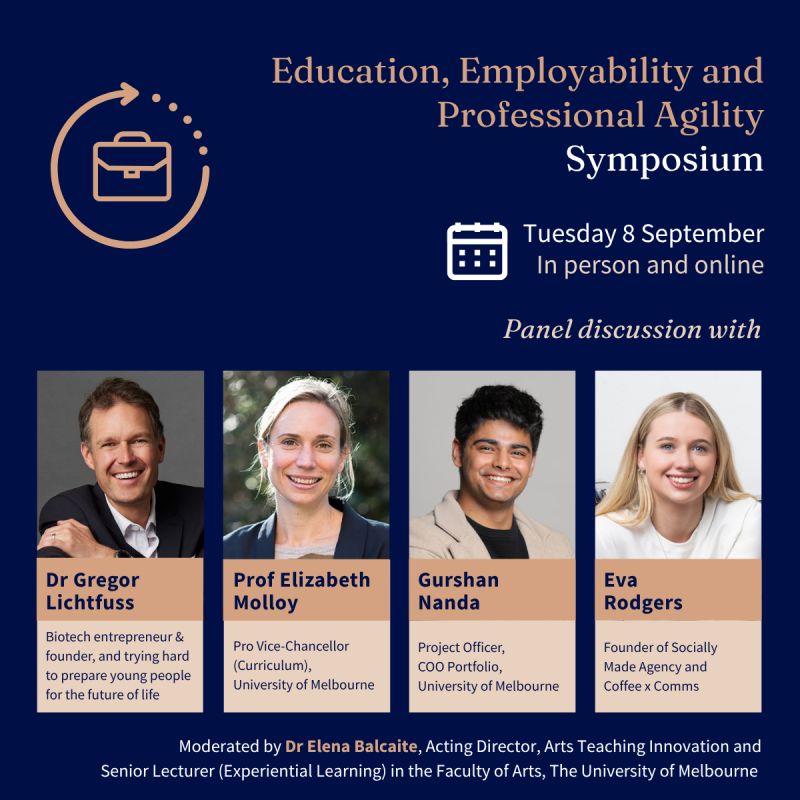
But Daniel asked me whether I would be interested in joining a panel about Education, Employability and Professional Agility - to provide an industry perspective.
I said yes before I had even thought about whether I had any good, constructive ideas on the topic. In fact, before I even knew what the Symposium really was about in detail.
I said yes, because I think this is a topic that matters.
And over the recent weeks, the preparation for the symposium gave me an opportunity to think more deeply about the core question that occurred to me earlier: what a university is for, especially at a time when the learning content is free and freely available.
I intend to publish it here, in five short pieces following the symposium.
This post is part of The Third Nexus Series - What a university is for when the content is free.